




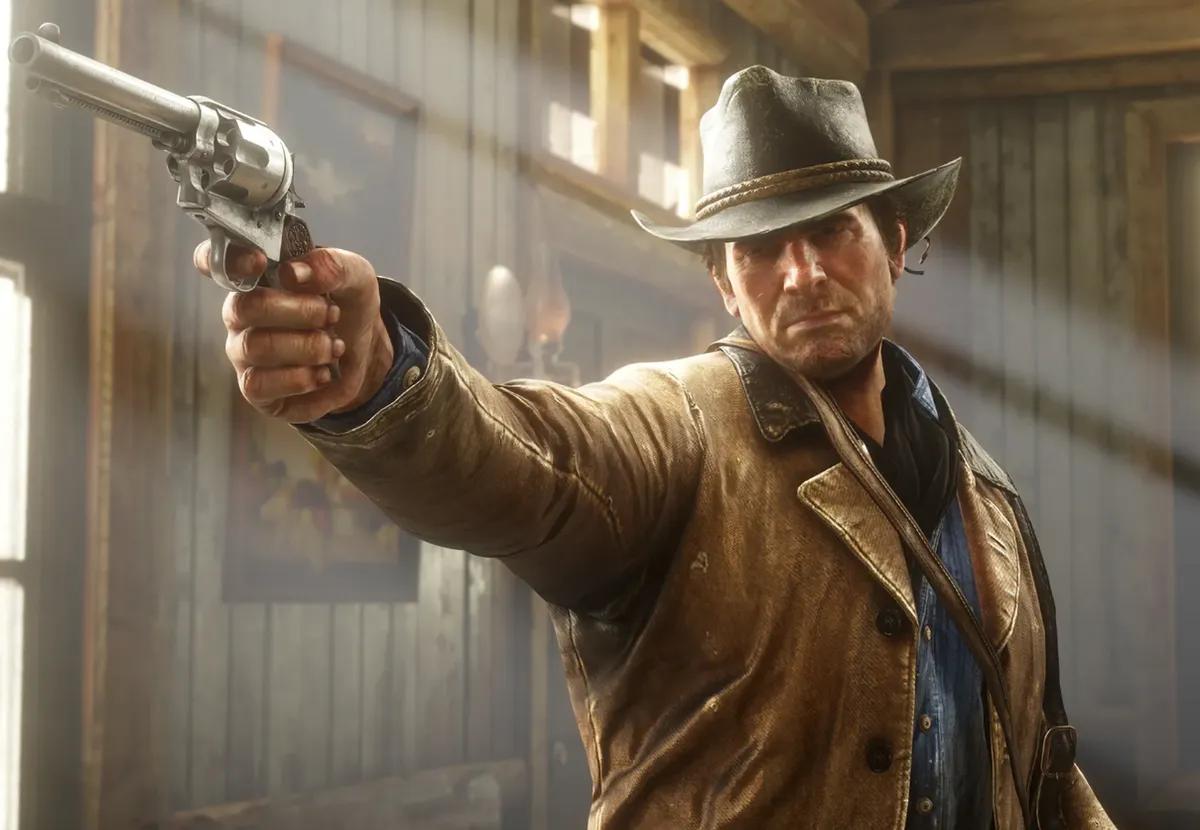
RAGE Motorunun Tarihi ve Rockstar Games'in Başyapıtları: GTA, Red Dead ve Diğerleri










 GTA VI
 PlayStation
 Xbox
Xbox Steam
SteamThe RAGE engine started inside a small California studio that made film effects, ported Resident Evil 2 to the Nintendo 64, then built a western shooter for Capcom. Rockstar Games bought that studio, kept its tech, and turned it into the Rockstar Advanced Game Engine. RAGE went on to run the HD era of GTA and every entry in Red Dead Redemption. The same engine, rebuilt many times over, now powers GTA 6.
RAGE: Beginning & Game Changer Destiny Again (and Again)
Diego Angel founded Angel Studios in 1984 in Carlsbad, California. It was not a games company. It produced 3D graphics for hire, and its first money came from film and music work.
The studio worked on the 1992 film The Lawnmower Man and on Peter Gabriel's "Kiss That Frog" music video, which won Best Special Effects in a Video at the 1994 MTV Video Music Awards. Angel ran the place on what he called the three P's: passion, patience and perseverance. He chose projects that showed off his team's technology rather than the ones that paid the most.
People from the early days describe Angel as someone who ran the company like a family and liked to throw parties. On Friday evenings, he would break out the tequila and tell everyone to wind down. The work was serious; the office was not.
In the early 1990s the studio made demos for Silicon Graphics in exchange for the company's high-end computers. That work caught the eye of a Nintendo technologist, and three days after a meeting, Angel Studios signed on as a technical partner for the launch of the Nintendo 64. In February 1995 Nintendo named the studio to its Ultra 64 "Dream Team," a group of ten outside developers. One of the others was DMA Design, the studio that later became Rockstar North.

Strip away the marketing, and the engine's record is short and heavy. Here are the games RAGE has carried, before GTA 6 joins them:
- Rockstar Games Presents Table Tennis (2006)
- Grand Theft Auto IV (2008)
- Midnight Club: Los Angeles (2008)
- Red Dead Redemption (2010)
- Max Payne 3 (2012)
- Grand Theft Auto V (2013)
- Red Dead Redemption 2 (2018)
I read down that list and it looks like the strongest hand at the poker table, every title built with GOAT ambitions, and four of them turning those ambitions into the result to match. The four that delivered, Grand Theft Auto IV, Red Dead Redemption, Grand Theft Auto V and Red Dead Redemption 2, sit on a foundation poured by a horror port and a sports game. The story of how that foundation was laid runs through each title below.
Using the Nintendo deal as a push, Angel moved into game development without tying itself to one platform. It contributed art and cutscenes to the 1996 Sega Saturn game Mr. Bones. It built Major League Baseball Featuring Ken Griffey Jr. in 1998 and its sequel a year later, then made the racing game Midtown Madness for Microsoft in 1999.
One reason the studio kept landing Japanese contracts, Angel said, was trust. Western and Eastern studios were wary of each other at the time, and he was a rare American-based founder who got along with Tokyo publishers. He flew to Japan every month and brought six bottles of tequila each trip.
That relationship led to the contract that changed the studio. In 1999 a team of nine ported Resident Evil 2, a game that had shipped on two PlayStation discs, onto a single 64-bit cartridge, and added new features on top. Producer Stewart Spilkin said they were the first developer outside Japan to work directly with Capcom Japan.
Capcom liked the work and came back with an idea for a new game. That project became Red Dead Revolver, but before it shipped, the studio changed owners. Take-Two announced in November 2002 that it had bought Angel Studios, with its technology and its 125 employees.
The purchase had a second motive. Rockstar had been building Grand Theft Auto on RenderWare, an engine made by Criterion Games, and when EA bought Criterion in 2004, Rockstar wanted its own technology. It already liked Angel's in-house engine, renamed the studio Rockstar San Diego, and set it to work on new tech. That tech became the Rockstar Advanced Game Engine, RAGE.
The first game built in RAGE, in-house at Rockstar San Diego, was Rockstar Games Presents Table Tennis in 2006. From there the engine ran the studio's biggest releases for nearly twenty years. GTA 6, due later this year and expected to be the largest entertainment launch ever, runs on a version of RAGE you would barely recognize, yet at its core it is the same engine that drove a ping-pong sim and a western shooter in the middle of the 2000s.
Red Dead Revolver (2004)

Before Red Dead Revolver was a western, it was a S.W.A.T. game. Capcom's then chief operating officer Yoshiki Okamoto brought Angel Studios an idea for a single-player third-person shooter where the player controlled a tactical team of seven characters, each with different gear, switching between them through one building. The team built a prototype in about three months.
Okamoto's concept drifted. At one point it was a carnival on an island overrun by robots. Then it became a western, a genre Okamoto had wanted to revisit since the 1985 arcade shooter Gun.Smoke and after watching the film Blindman. Angel kept the acronym and gave it a new meaning: the Spaghetti Western Action Team, and Red Dead Revolver had a name.
The name itself came from Capcom's side, where employee Naoto Tominagi liked the rhyme of red and dead. It puzzled the American team, who tried to make it fit the game by naming the lead Red and burning his hand so it stayed red. About a year into development, Capcom sent its own staff to oversee the project, including Akira Yasuda, the artist behind Street Fighter 2's Chun-Li.
Yasuda pushed the look toward fantasy. One character was meant to be a giant Frankenstein figure in a dress, an idea the San Diego artists never warmed to. Yasuda himself rarely left the building and was known to sleep under his desk or in a closet.
Capcom unveiled Red Dead Revolver in March 2002, but behind the scenes the project stalled. Capcom would build, scrap and restart large pieces of the game. Because Angel was an independent studio on contract, missed milestones meant missed paychecks, and people began to wonder whether the game would ship at all.
Rockstar had already worked with Angel on Midnight Club and Smuggler's Run, and the Housers had long wanted to make a western. When Take-Two bought the studio in November 2002, Red Dead Revolver came along through later negotiations. Okamoto left Capcom soon after, and Capcom kept only the right to publish the game in Japan.
"Capcom were prepared to walk away from it."
— Dan Houser
In August 2003 Capcom publicly canceled the game. Four months later Rockstar re-announced it, though Rockstar San Diego had kept working on it the whole time. Jamie King moved from New York to oversee the project and the new engine, and Sam Houser gave him nine months to ship.
The studio crunched hard to stitch the loose pieces into a finished game. Rockstar shipped Red Dead Revolver on May 4, 2004, for PlayStation 2 and Xbox, roughly five years after the project began. It was a third-person shooter with arcade roots, a revenge story about Red Harlow hunting his parents' killer, and a campaign that handed the player five other characters with their own moves.
That multi-character structure resurfaced years later in Grand Theft Auto V. The slow-motion targeting that let players line up shots became the seed of Dead Eye. Revolver was not open world, and some at Rockstar were frustrated by its middling reviews, but it gave the company a western to build on.
The line back to that Resident Evil 2 port is short. The same studio that crammed Capcom's horror game onto a cartridge in 1999 was now making Capcom's western, then making it Rockstar's. The shooter genes were in the building from the start.
Rockstar Games Presents Table Tennis (2006)

When the Xbox 360 and PlayStation 3 generation arrived, people expected Rockstar's next move to be loud. Instead, in 2006, the company announced Rockstar Games Presents Table Tennis. No violence, no satire, no cinematic story, just a serious simulation of a sport nobody else had bothered to simulate.
The game was deep and fast, a one-on-one sport built on a few characters and an online mode that drew its own crowd. A short trip into the tutorial showed how seriously it took spin, placement and timing. The roster still carried a Rockstar smirk, with the towering Nordic Jesper and Luc and his ponytail.
Rockstar said the team simply loved table tennis. Co-founder Sam Houser framed it as the company doing what it always did, taking a subject it found interesting and that no game had handled well.
"table tennis fitted the bill perfectly."
— Sam Houser
The practical reason sat in plain view. Rockstar wanted to learn the new console hardware early, and a tight sports game was a clean way to test realistic human characters. Table Tennis was an Xbox 360 exclusive because the PS3 was not out yet, and a Wii version followed in 2007.
Its real place in history is technical. Table Tennis was the first game built in RAGE, in-house at Rockstar San Diego, the same studio that finished Red Dead Revolver. Revolver had started under Capcom on the studio's older engine, which makes the ping-pong game the first true Rockstar title on the tech that would later carry GTA and Red Dead.
I think it suits Table Tennis to stand apart in this lineage, since it was the first full Rockstar game on RAGE while Revolver had begun life under Capcom, and that gives a ping-pong sim the charm of a clean chapter break. The detour reading misses what the game actually was.
Rockstar released it on March 23, 2006, a few months after the Xbox 360 launch, at 40 dollars, below the 60-dollar price the industry was drifting toward. GameSpot's Ryan Davis compared it to Pong, both stripped to essentials, and praised some of the most realistic player characters in a game at the time. Houser had said he wanted a sports game with the intensity of a fighting game.
The 2007 Wii version moved the controls to the remote and worked, but Davis noted the lag between a swing and the on-screen reaction. Nintendo's controller would not reach close to one-to-one motion until the later MotionPlus add-on. The Xbox version stayed the definitive one, and it remains playable through backward compatibility.
I see Table Tennis the way you notice one odd guest at a long table, the sports game that earns its seat among Rockstar's stories about criminals on horses and in cars precisely by being nothing like them. Its difference is the point, not a flaw.
Rockstar never made a sequel, and table tennis became the kind of activity that turns up as a mini-game inside the GTA world rather than a standalone release. As a one-off it looks like a curiosity. As the first RAGE game it looks like a starting gun.
Grand Theft Auto IV (2008)

Grand Theft Auto IV arrived in 2008 as the first HD entry in the series. A decade later its age shows in small ways, like Niko Bellic's phone with physical buttons and no internet. At release it looked like a generational jump, the same kind Gears of War and Oblivion had shown.
GTA 4 ended the wave of GTA 3 imitators because no one else could build a city that looked and sounded like Liberty City. Its story followed Niko Bellic, a Serbian war veteran who comes to the city for a fresh start and is pulled into work for Russian gangsters and his cousin Roman. He is easier to like than the three leads Rockstar would write next, and the game lets the player shape who he becomes.
Liberty City was Rockstar's compressed New York, with Algonquin standing in for Manhattan and Star Junction for Times Square. Rockstar had gone from the cardboard buildings of San Andreas to this in a little over three years. The city, more than Niko, is the part people kept returning to.
GTA 4 introduced cover shooting to the series, since gunfights had been the weak point of the older games. The gunplay feels dated now and the melee is clumsy. The driving is stiff and punishing, which some players read as realism.
Microsoft reportedly paid around 50 million dollars for timed exclusivity on two expansions, The Lost and Damned and The Ballad of Gay Tony, released in 2009. Each ran about eight hours with its own lead, the biker Johnny Klebitz and the fixer Luis Lopez. Both men had appeared briefly in Niko's story, and their separate angles on the city fed directly into the three-protagonist idea behind GTA 5.
The game also brought branching choices to the series, including one where the player decides which friend lives or dies. Those moments were rare for big games then and still are. They let the player determine Niko's morality.
"rediscovering the player-driven chaos that people longed for."
— Sam Roberts
Not everything worked. The friend system, where Niko's pals call to go bowling or fly a helicopter, became a running joke for how needy it was, and GTA 5 dropped it. The arsenal also felt restrained next to San Andreas and its jetpacks and flamethrowers, and the expansions added the explosive toys the base game held back, like satchel charges and a rocket-equipped helicopter.
The campaign buries its best work deep, behind a long opening tutorial of about four hours. The standout is "Three Leaf Clover," a bank robbery with the bickering McReary brothers that turns into a street and subway firefight, and it became the template for GTA 5's heists. "Final Interview" and the helicopter chase of "Paper Trail" show how a good hook lifts an otherwise basic setup.
GTA 4's online free mode was a rough prototype of what GTA Online became, a space where players hunted each other for laughs. The game taught Rockstar how to tell a heavier story in a real-feeling world, lessons that carried into Red Dead Redemption two years later. All of it ran on RAGE, the engine's first outing at open-world scale, and GTA 4 is the first of the four RAGE games that delivered on the engine's ambitions.
The parallel between Niko Bellic and John Marston is hard to miss. Both are men who cannot outrun their old lives while someone else calls the shots. GTA 4 earned its grim immigrant story, and the city it built still holds up.
Midnight Club: Los Angeles (2008)

Midnight Club's roots reach back to the same studio that became Rockstar San Diego. In 1999, Angel Studios made Midtown Madness for Microsoft, an open-world driving game set in Chicago with licensed cars. A sequel followed about 16 months later, adding London and San Francisco.
Angel's first racing game for Rockstar was Midnight Club: Street Racing in 2000, a PlayStation 2 launch title set in London and New York. Players started in a yellow taxi and worked up by flashing their lights at rivals and chasing them through checkpoints. By today's standard, it is primitive, but its open city helped point the way for later driving games.
By 2003 the studio, now Rockstar San Diego, expanded the series with Midnight Club II on Xbox, PC and PS2. It added Los Angeles, Paris and Tokyo, plus motorcycles. The same year, Need for Speed: Underground arrived and took the street-racing spotlight.
Midnight Club 3: DUB Edition in 2005 leaned hard into car culture, with licensed vehicles, deep customization and a tie-in with DUB magazine. It traded the globetrotting for Atlanta, San Diego and Detroit, and added cash to earn. A 2006 Remix added cars, races and a reworked Tokyo, and many fans still call this entry the high point.
The last Midnight Club arrived in 2008. Midnight Club: Los Angeles gave players a detailed, slightly too-yellow recreation of the city, an in-game phone with a QWERTY keyboard, and a map you could zoom out of in a quasi-3D view that felt ahead of its time.
Progress was slow at the start. Players began in a humble hatchback, and the early grind toward a faster car tested patience. The 16-player online mode was the real draw.
"stay true to the hardcore gaming experience the series is known for."
— Jay Panek
A 2009 Complete Edition bundled the downloadable extras, including a South Central content pack that added a new area. After that, Midnight Club went quiet. Los Angeles ran on RAGE, made by the same San Diego team that built the engine, which makes it the engine's racing chapter.
The reason the series stopped is the reason a lot of old Rockstar series stopped. By August 2021 the company was making about 2.5 million dollars a day from GTA V alone, and it had released only three all-new games in a decade. Keeping the online money flowing mattered more than a new street racer.
In the PlayStation 2 years, Rockstar could ship several different games across genres in a single window. Midnight Club sat next to The Warriors, Manhunt and the Max Payne games. That spread is gone, and Midnight Club: Los Angeles is the end of it.
Red Dead Redemption (2010)

Red Dead Redemption was the game Sam Houser had wanted to make when Rockstar bought the rights to Revolver. Rockstar San Diego built it as the open-world western the first game never tried to be, and it shipped on May 18, 2010.
The reviews were strong and the sales were huge. By February 2017 it had sold more than 15 million copies, and it sits on most lists of the best games ever made. Spilkin said Sam Houser loved The Wild Bunch and that the film shaped the game.
Redemption kept the western look of Revolver and wrapped it in Rockstar's open world. It followed John Marston, a former outlaw forced to hunt down his old gang. The slow-motion shooting of Revolver returned as Dead Eye, refined and central to combat.
Marston and Niko Bellic became the two single-player odysseys Rockstar measured itself against. When the company started GTA 5, the question it set itself was how to top one of them with a single lead, which pushed it toward three. Marston's arc, a man trying and failing to leave violence behind, is the spine of the whole Red Dead idea.
Then there is the part people remember as a curveball, the Undead Nightmare expansion that filled the frontier with zombies.
I know the zombies look like a setting joke, but from the game-design side they sit inside Red Dead's lore cleanly, an extension of the same studio DNA that ran from a horror port to a western shooter, not a costume thrown over it. The team had horror tools in hand long before it had cowboys.
That reading is not as strange as it sounds. The studio's first real break was porting Resident Evil 2 in 1999, and survival-horror systems were part of its history from the beginning. Undead Nightmare looks less like a stunt when you trace the team's path rather than the hats and spurs.
Red Dead Redemption ran on RAGE, and it is the second of the four games that paid the engine's ambitions off. It proved Rockstar could carry a heavy, serious story across a wide world without a city to lean on. Diego Angel, by then long gone from the studio, was surprised years later to learn the series was still running.
Six years after Redemption, Rockstar announced a prequel. The studio that built the engine, the western and the open world would put all three together one more time. The result would become the engine's largest test yet.
Max Payne 3 (2012)

Max Payne 3 is the odd entry, a game built on someone else's character. Remedy created Max, and Rockstar took him over, releasing the third game in 2012. It is at once better and worse than the first two.
Max came with a fixed personality, all wry cynicism and heavy similes, set against the snow and grime of New York. Rockstar's instinct is the wide open world and life simulation. Max Payne is a tight action shooter that lives or dies on style, which made the pairing risky from the start.
What Rockstar brought was firepower. The 2012 game has more intense shootouts and far better visual effects than its predecessors, with production values to match a film. Bullet-time, the series' signature, met Rockstar's procedural animation tech, and enemies crumple and clutch at wounds as they fall.
Rockstar's Vancouver studio handled the environments. Max's fights through a Sao Paulo nightclub and a sun-drenched favela rival the company's best work, and the New York flashback levels bring back the snowy city of the older games. Several critics called those New York stages the visual peak.
The band HEALTH wrote the soundtrack, and the music turns the shooting into something that feels powerful. The final airport corridor, scored to the track "Tears," is one the game is remembered for. The opening, where Max drinks himself lower while a darker version of the Max Payne 2 theme plays, sets the tone fast.
The tone is also the problem. The first two games carried a self-aware edge that kept Max cool; the third takes itself far more seriously and curses to prove it. Rockstar's cinematic habit hurts the flow too, with cutscenes cutting in so often that the player sometimes takes a few steps before the next one starts.
Most of the villains are forgettable, introduced and killed too quickly to land, like the corrupt cop Bachmeyer or the politician Victor behind an organ-harvesting scheme. Dan Houser wrote and emulated Sam Lake's elaborate narration, and Max keeps his voice even with a shaved head and a new beard. James McCaffrey, who voiced Max across the series, gave the character its center.
The combat is the meatiest in the series. Aim is precise, enemies soak up body shots, and the game pushes the player toward headshots, which pairs well with bullet-time and a cover system used as an option rather than a crutch. Max is heavier here, and a missed shoot-dodge into a wall leaves him slow to recover.
"Max Payne 3 shows us Rockstar, warts and all."
— Rick Lane
Stripped of an open world, Rockstar's tics are easier to see, the love of cinematics and the bleak view of people. Max Payne 3 ran on RAGE between Red Dead Redemption and GTA 5, and it reads now as the engine flexing in a single corridor rather than across a continent. It is not one of the four masterpieces, but it shows what the tech could do aimed narrow.
Grand Theft Auto V (2013)

Grand Theft Auto V landed in 2013 after a five-year wait, with the largest world the series had built and a scale people called the first next-generation game. Dan Houser walked a journalist through an early demo in New York in late 2012, describing how Rockstar starts a new GTA.
The first decision was the place. Rockstar picked Los Angeles because San Andreas had only touched it, three small villages and some countryside, and the team felt it had not done the city justice. Los Santos gave them mountains, desert and coast around a dense city.
Then came the characters. Niko and John Marston had been single-player odysseys, and Rockstar asked how to beat that with one lead. The answer was three: Franklin, Michael and Trevor, with the story growing out of who the player would most want to follow.
That three-character switch did not come from nowhere. Red Dead Revolver had handed players five perspectives back in 2004, and GTA 4's expansions had split Liberty City across new leads. GTA 5 pulled the idea into the main game.
The connections run through the cast. Trevor kills Johnny Klebitz, the biker lead from The Lost and Damned, early in the game, closing a loop from the GTA 4 era. The "Three Leaf Clover" heist from GTA 4 became the model GTA 5 ran with, especially in GTA Online's co-op heists.
Rockstar's approach to acting had changed too. The company stopped using the phrase voice actor in 2008 and moved to full performance capture, the same person doing voice and body in one session.
"We gave up the phrase voice actor in 2008."
— Dan Houser
Houser described a mo-cap setup he said only Weta and James Cameron could match, with director Rod Edge running it since GTA 4. The shift had started by accident on San Andreas, when a comedian stormed out of a recording session and the team realized the on-set performer was better. Bully used the same method right after.
Houser talked about Rockstar's work as a single thing, where story and game design are not separate departments. The goal was for players to stop noticing the parts and live in the whole. Missions that worked on paper but not in play got cut and rebuilt.
GTA 5 became the biggest launch in entertainment history and kept earning for years, about 2.5 million dollars a day as of August 2021. It ran on RAGE, and it is the third of the engine's four proven masterpieces. GTA Online turned a single release into a decade-long business.
That success reshaped Rockstar. The company that once shipped Midnight Club, Manhunt and Max Payne in the same era now puts years into a single world and the online economy around it. GTA 5 is the clearest reason the release calendar shrank.
Red Dead Redemption 2 (2018)

Red Dead Redemption 2 shipped on October 26, 2018, on PlayStation 4 and Xbox One, with a PC version in November 2019. It scored 97 on Metacritic and had the second-biggest launch in entertainment history, behind GTA 5, with 725 million dollars in its opening weekend and more than 23 million copies shipped.
The game is a prequel set in 1899, following Arthur Morgan and the Van der Linde gang as the West closes in around them. Federal agents and bounty hunters chase the gang across the country after a robbery in Blackwater goes wrong. The story circles Dutch van der Linde, John Marston and Micah Bell.
Development started in 2010 as the first Redemption wrapped. Dan Houser had a broad outline by late summer 2011, and by autumn 2012 the missions were taking shape. The final main-story script ran about 2000 pages, and with side content Houser said the stack would stand eight feet high.
The motion-capture work took 2200 days and 1200 actors, 700 of them with dialogue. The first sessions ran in 2013 at Rockstar's Bethpage studio in New York, directed by Edge. Composer Woody Jackson came on in 2015 to write 192 interactive mission scores.
By mid-2017 the acting was finished and the story ran about 65 hours, before Rockstar cut a 5-hour stretch. Arthur originally had two love interests, and one was dropped because it did not work. A train mission with bounty hunters was removed for being fun at first and then not.
The game pushed detail further than any Rockstar release before it. Arthur's hair and beard grow, he has to eat, sleep and bathe, his weight shifts his health and stamina, and skinning an animal is its own deliberate act. The honor system tracks how he treats the people around him.
"We try to give you options within a lot of these missions."
— Rob Nelson
The plot borrows the shape of Reservoir Dogs, a gang surviving the aftermath of a robbery the player never sees, complete with an informant inside the group and a final three-way standoff. Rockstar credited 3168 people in its thank-you letter, and with the actors the real figure sits around 4368. It is the engine's largest test and the fourth of its proven masterpieces.
I trace part of that Resident Evil 2 port's DNA right into Red Dead Redemption 2, and the line from a nine-person team squeezing a horror game onto a cartridge in 1999 to a studio of thousands building this still surprises me. The cartridge and the 100-gigabyte open world share a bloodline.
That line is the whole point of RAGE. The engine grew from a contractor's in-house tech into the thing that ran four of the most ambitious games of their generations, and the next one, GTA 6, sits on a rebuilt version of it. The same code that drove a ping-pong sim now aims to be the biggest entertainment launch ever made.
Which leaves one wish that has nothing to do with engines and everything to do with the cast RAGE has built.
I need the Table Tennis crossover more than almost anything on my Rockstar list: Trevor Phillips across the net from Niko Bellic, Arthur Morgan against Michael De Santa, CJ against a young Jimmy De Santa, all of it pure fantasy and now my number one entry under games we need. None of it will happen, and that does not stop me wanting it.
The fantasy is impossible, but it sits on something real. Every one of these characters runs on the same engine, born from a port nobody expected to matter and a sports game nobody asked for. GTA 6 will add the next name to that list.


 Başarıyla kopyalandı... İçeriğimizi paylaştığınız için teşekkür ederiz!:



100 mücevhere kadar %5 para yatırma bonusu

Para yatırma ve çekme işlemlerinde %0 ücret.





11 Para Yatırma Bonusu + FreeSpin


EKSTRA %10 PARA YATIRMA BONUSU + ÜCRETSIZ 2 ÇARK DÖNDÜRME

Ücretsiz Kasa ve %100 Hoş Geldin Bonusu


5 Ücretsiz Kılıf, Günlük Ücretsiz ve Bonus

3 ücretsiz kasa ve tüm nakit para yatırma işlemlerine %5 bonus eklenir.

Depozitoya +%5




Yorum