





Eski PlayStation yöneticisi, konsol oyunlarının satış tavanını aşması gerektiğini söylüyor.










 Oyunlar
 PlayStation
 Xbox
Xbox Nintendo
Console gaming has reached a structural limit, according to Shawn Layden, the former president and CEO of Sony Interactive Entertainment America, and breaking through it will require a shift as large as the one that ended the Betamax era. Speaking on the Pause for Thought and Naomi Kyle YouTube channel, Layden said global console sales have stalled at roughly the same level for decades, regardless of generation or brand strength.
“We talk about gaming as being this $250 billion industry, which it is, and have hundreds of millions of users, which it does,” Layden said.
“But the number of discrete consoles sold over any particular generation caps out about 250 million.”— Shawn Layden
Layden pointed out that this figure holds even when combining all major platforms in a generation. PlayStation, Xbox, Nintendo, and past competitors collectively reach the same ceiling. The only major deviation came during the Wii era, when Nintendo’s motion-focused console pushed sales closer to 300 million units by attracting players outside the traditional gaming audience. Layden described that moment as an anomaly rather than a lasting expansion.
“We need to crack that cap, that barrier,” he said.
Shawn Layden recently revisited another long-running industry concern, arguing that modern games take too long to make, cost too much to produce, and demand more time from players than most audiences can realistically give. In an interview with Game Rant’s Character Select, he said development cycles stretching five to seven years and budgets climbing into the hundreds of millions are misaligned with how players live today, especially as the average age of the gaming audience continues to rise.
To explain how console gaming might move beyond its current limits, Layden turned to a historical example from consumer electronics. In the late 1970s and 1980s, Sony’s Betamax lost the videotape format war to VHS, despite offering comparable or superior quality. The deciding factor, Layden argued, was not technology but licensing.
“Betamax lost to VHS for one reason only: that VHS licensed its format across many different manufacturers,” Layden said.
Sony kept Betamax tightly controlled, while VHS spread through broad licensing deals that allowed multiple companies to manufacture compatible players. That approach made VHS more common in homes and video rental stores, pushing the market to coalesce around a single standard. Layden said similar thinking later guided the compact disc, DVD, and Blu-ray formats, where companies competed on hardware features rather than locking content behind incompatible systems.
“People didn't understand the need to have the same machine as your neighbor,” he said.
“Once your neighbor has picked VHS and you want to watch that tape, but you have Betamax, all of a sudden… So the industry coalesced around VHS.”— Shawn Layden
Layden believes console gaming needs an equivalent moment: a shared gaming format supported by a consortium rather than three isolated ecosystems. In his view, manufacturers could still compete on design, performance, and features, but games would run across all compatible devices.
“I think we need to get in a world where we have a gaming format,” Layden said.
“We have licensing programs which allow other manufacturers to build into that space, and then you can talk about real numbers moving.”— Shawn Layden
Such a shift would mark a radical break from how consoles operate today. It would also signal the effective end of traditional console exclusives, a cornerstone of platform strategy for decades. Layden acknowledged the tension, arguing that exclusives still carry brand value even if they should not define every release.
“I don't think every game has to be console exclusive,”
“But I do accept the fact that if you're going to have platform companies like Sony and like Nintendo, there is a huge value to the brand of having strong exclusives.”— Shawn Layden
He framed the idea with deliberate exaggeration. “If Mario starts showing up on PlayStation, that's the apocalypse,” Layden said, adding that characters like Mario or Nathan Drake give their platforms identity and pull.
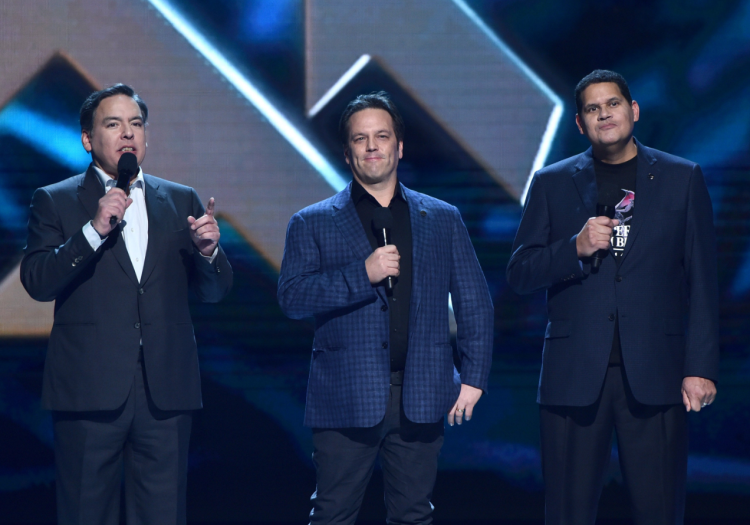
Shawn Layden, Xbox boss Phil Spencer, and former Nintendo of America chief Reggie Fils-Aime at The Game Awards 2018. Photo by Alberto E. Rodriguez/Getty Images. (via IGN)
Whether Sony, Microsoft, and Nintendo would ever agree to such a shared standard remains doubtful. Microsoft has moved closest through its multiplatform publishing strategy and emphasis on Xbox as a service spanning console, PC, and cloud. Sony has selectively released first-party titles on PC and, in rare cases, rival consoles, but still relies heavily on hardware-driven exclusivity. Nintendo remains the most insular, with its flagship franchises tied tightly to its own systems.
For now, each company continues along its established path. Sony is preparing the groundwork for a future PlayStation 6. Microsoft has confirmed plans for another Xbox generation, potentially blurring the line between console and PC. Nintendo has just launched the Switch 2, reinforcing its hybrid approach rather than abandoning proprietary hardware.
Layden’s argument does not predict an immediate shift, but it reframes a problem the industry has quietly accepted. Console gaming, despite its cultural reach and financial scale, has struggled to grow its hardware audience beyond a fixed boundary. His comparison to VHS suggests that the solution may lie less in faster chips or sharper graphics, and more in who is allowed to build the box that plays the games.


 Başarıyla kopyalandı... İçeriğimizi paylaştığınız için teşekkür ederiz!:



100 mücevhere kadar %5 para yatırma bonusu

Para yatırma ve çekme işlemlerinde %0 ücret.





11 Para Yatırma Bonusu + FreeSpin


EKSTRA %10 PARA YATIRMA BONUSU + ÜCRETSIZ 2 ÇARK DÖNDÜRME

Ücretsiz Kasa ve %100 Hoş Geldin Bonusu


5 Ücretsiz Kılıf, Günlük Ücretsiz ve Bonus

3 ücretsiz kasa ve tüm nakit para yatırma işlemlerine %5 bonus eklenir.

Depozitoya +%5




Yorum