





Super Meat Boy 3D İncelemesi










 Review
 Steam
Steam PlayStation
 Xbox
XboxSuper Meat Boy 3D arrives sixteen years after the 2010 original, developed by Sluggerfly alongside Team Meat — though series co-creator Edmund McMillen, who departed the studio roughly a decade ago while working on Mewgenics, is again absent from the credits. The premise requires no elaboration: the same pint-sized cube of meat, the same Dr. Fetus, the same Bandage Girl, the same buzzsaws and spike traps and instant-kill hazards, now placed inside five main worlds of 3D platforming levels alongside harder dark world variants. The question every preview, demo, and early hands-on circled around was whether the precision that made the original a landmark of the Masocore genre could survive the addition of a full third dimension. Based on the finished game, the answer is partial — the movement translates convincingly, the level design does not always follow.
The Premise and What Carries Forward
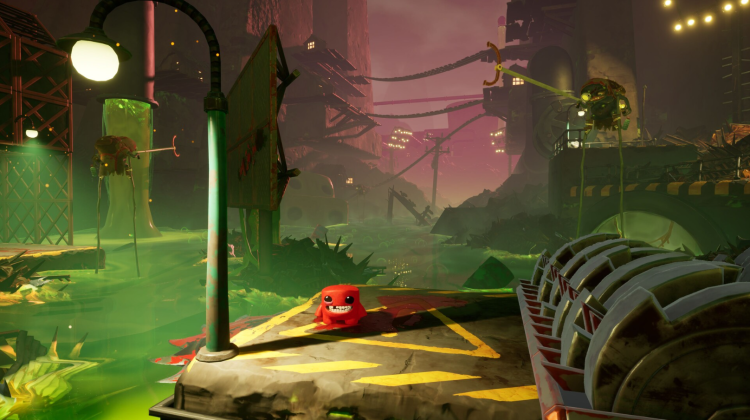
The structure matches the original without modification. Meat Boy runs through precisely constructed obstacle courses to reach Bandage Girl at the end of each stage, only to have Dr. Fetus snatch her away to the next. No combat exists. The only tools available are movement, patience, and the willingness to attempt the same level through fifty or sixty deaths until the path resolves itself. Upon completing a level, a replay shows every failed attempt simultaneously, all the red-splatted Meat Boys scrambling forward at once while the single survivor reaches the end. The sarcastic loading screen messages urging players to improve remain. The irreverence of the original is intact, including a warp pipe gag that nods to Super Mario Bros. The game is not attempting to recontextualize what Super Meat Boy is. It extends the formula into a new dimension and asks whether the formula holds.
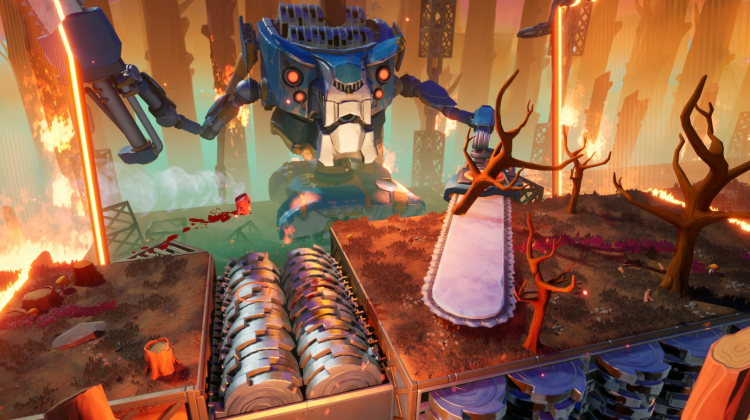
Edmund McMillen's art style has been pushed into 3D with enough detail to populate backgrounds in ways the original could not. Beavers flee from Dr. Fetus's robots as they cut down forest sections. Strange tall-legged creatures root through toxic waste in the background. Meat Boy accumulates progressive physical damage as his death count rises within a stage, eventually exposing bones and dislodging an eye. These details sit beneath what is primarily a mechanical exercise, but they demonstrate that the transition to 3D was not purely a technical decision — the world expands visually as well as spatially.
Movement and New Mechanics
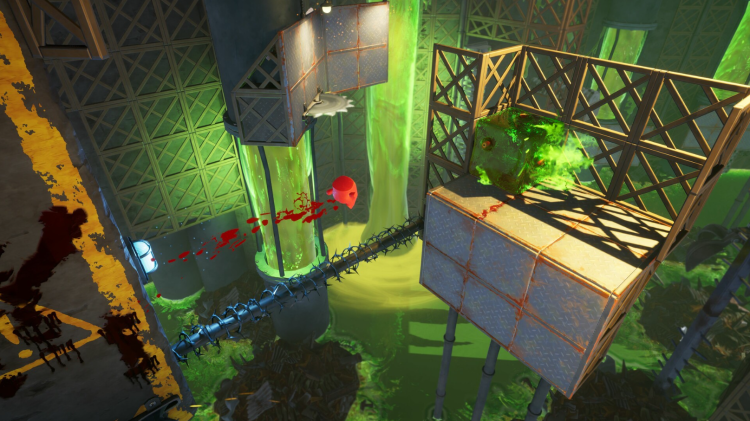
The core movement survives the transition. Wall jumping, wall running, and Meat Boy's specific jump arc — the same weighted, responsive feel from the 2010 game — arrive intact. The wall run is the primary new addition, allowing Meat Boy to slide laterally along surfaces that the third dimension now positions at angles rather than always face-to-face. A mid-jump air dash extends distance and speed, functioning as the primary tool for achieving A-plus completion times and reaching hidden bandages tucked into the corners of levels. Both additions integrate cleanly with what the original established rather than sitting alongside it as separate systems.
I played through the full five-world campaign and found the movement to be the game's most consistently realized element — tight enough that the wall jump and dash chain together with the same tactile satisfaction as the 2D games, loose enough in its physics that speedrunners will find sequences to exploit and entire sections to skip with well-timed jump combinations. That looseness is by design in one sense and a problem in another. The precision the original demanded in two dimensions does not map directly onto three. Meat Boy's movement in 3D space creates situations where the physics produce unexpected outcomes that the player must learn and account for in each new level, rather than situations that follow predictably from established movement rules.
Level Design and Difficulty
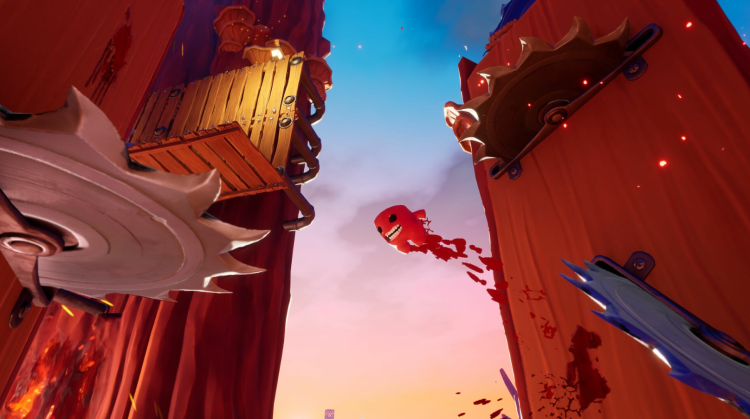
Five main worlds contain fifteen levels each, plus dark world variants of every stage and secret levels distributed across the game. Players do not need to complete all fifteen levels in a world to unlock the boss, which introduces a degree of flexibility the series has not previously offered. Boss designs vary significantly in difficulty — the first boss is an auto-scrolling chase sequence that functions as one of the game's hardest levels, while the fourth boss took some players fewer than a dozen seconds to solve after working out the sequence. The difficulty curve oscillates rather than climbing consistently, which can disorient players expecting the gradual escalation the original delivered.
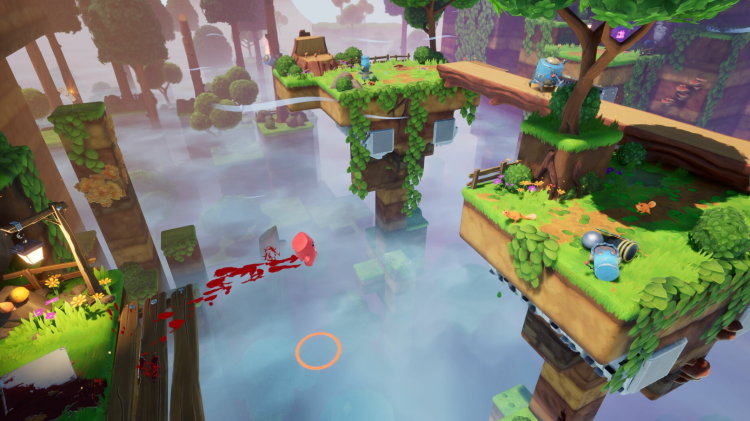
The level design clutters faster than the original. New obstacle types arrive quickly — robots that cut down sections of the environment, branching paths, environmental acid dripping from background pipes, gravity-manipulation segments in the late game. Individually, each new element tests specific movement skills. Together, they generate a visual density that the original deliberately avoided. The 2010 Super Meat Boy used minimalist stage construction so that hazards read instantly at the game's speed. In 3D, background details and foreground obstacles occupy the same visual space. Deaths that come from background pipes the player was not engaged with, or from hazards obscured by the level geometry, produce a different frustration than deaths from traps the player understood and simply failed to clear. The latter is the entire point of Masocore design. The former undermines it.
Camera Problems
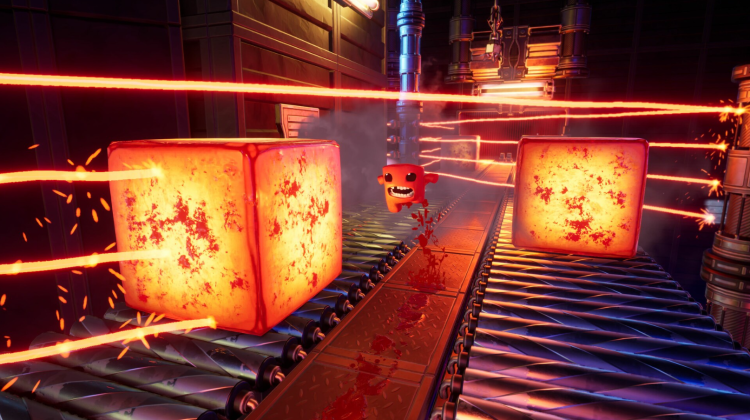
The fixed camera is the game's most consistently criticized technical element across multiple review sources, and the criticism is specific enough to describe precisely. When the camera positions itself at a distance directly behind Meat Boy, the player can read the level layout ahead, make jump decisions mid-movement, and maintain the flow the game demands. When the camera rotates to accommodate a different level design, that spatial orientation breaks. Running straight forward becomes running at a diagonal to avoid a wall of spikes, but the camera angle makes that diagonal difficult to calculate before contact. Wall jumps from flat surfaces require players to judge their position in 3D space from a fixed viewpoint that may not show them where they are standing relative to the landing target. Meat Boy is small on screen relative to the environments around him, and busy machinery spinning in the background makes him harder to track during the sequences where tracking him matters most.
A dedicated suicide button exists, which proves useful in cases where Meat Boy lodges inside level geometry — an edge case that appeared often enough in playthroughs for reviewers to note it. The camera issues are not edge cases. They appear consistently across specific level types and constitute an added difficulty layer that sits outside the game's intentional challenge design.
Secrets and Replay Value
The secret content is substantial. Bandages hide in every stage. A-plus time targets require mastery of the dash and wall run chains to achieve. Hidden characters are available as unlockable rewards, including guest appearances from Bing Bong from the game Peak and a Half-Life Headcrab, alongside original additions like Meat Ball Boy and Cheese Boy, each carrying unique move properties. Secret worlds exist beyond what the main campaign makes visible, and after fifteen hours, players report still hunting content. The breadth of optional challenges and collectibles matches the original game's approach to rewarding persistent engagement well beyond the base campaign completion.
The respawn time sits a millisecond or two longer than it should for a game that demands hundreds of attempts per session. The level completion timer starts before the player has made their first input, which forces restarts in time-attack attempts and erodes focus. Neither issue is significant in isolation; across hundreds of level attempts in a single session, they register.
The 2D-to-3D Question
Super Mario 64 is the reference point multiple reviewers reach for when assessing the ambition of the jump, and the comparison exposes what Super Meat Boy 3D declines to attempt. The 2D-to-3D shift in 1996 allowed Nintendo to redesign Mario's moveset, establish new level objectives, and rethink how a player interacts with a game world at a structural level. Super Meat Boy 3D treats the dimension change as a perspective shift rather than a design opportunity. The formula, the structure, the objective, and the tone are unchanged. The extra dimension adds wall runs, air dashes, and 3D obstacle configurations, but does not generate new questions about what Super Meat Boy is or what it could become. Dr. Fetus' Mean Meat Machine — a spinoff that applied Super Meat Boy's design principles to a Puyo Puyo structure — demonstrated that the series has the capacity to interrogate its own fundamentals. Super Meat Boy 3D does not pursue that capacity.
I think the game succeeds at delivering more Super Meat Boy within the constraints it sets for itself, and fails to exceed those constraints in ways that would make the transition to 3D feel necessary rather than incremental.
Verdict
Super Meat Boy 3D is a 7/10 game. The movement system survives the dimensional shift with its precision largely intact, the secret content provides dozens of hours of optional challenge beyond the main campaign, and the core Masocore loop — learn, fail, advance, repeat — still generates the specific cycle of frustration and satisfaction the series built its identity on. The fixed camera and cluttered level design introduce a category of unfair death the original worked hard to exclude, and the game's decision to replicate rather than reinvent the formula means the most interesting question the project could have answered remains unasked.
Pros:
- Wall jumping, wall running, and Meat Boy's specific jump arc carry forward from the 2D games with precision intact
- Secret characters, hidden bandages, A-plus time targets, and secret worlds extend the content well beyond fifteen hours of base campaign
- New obstacles and 3D spatial configurations introduce fresh trap design without abandoning the original's level-length brevity
Cons:
- Fixed camera angles create depth perception failures on specific level types, generating deaths that fall outside the game's intentional challenge design
- Background visual density and environmental clutter obscure hazards in ways the minimalist original avoided by design
For players who want more Super Meat Boy and accept the camera limitations as a manageable tradeoff, the game delivers on that request fully. The five worlds, dark world variants, and unlockable content constitute a robust package for the audience that returns to this franchise for the specific punishment it provides. Whether that audience finds the camera and design density issues tolerable or game-breaking will determine how many hours they log before the frustration shifts from satisfying to structural.
Exploring the Best Single Player Games 2026 is a reminder that solo gaming still offers some of the most immersive stories, memorable characters, and emotionally rich experiences you can enjoy at your own pace.


 Başarıyla kopyalandı... İçeriğimizi paylaştığınız için teşekkür ederiz!:



100 mücevhere kadar %5 para yatırma bonusu

Para yatırma ve çekme işlemlerinde %0 ücret.





11 Para Yatırma Bonusu + FreeSpin


EKSTRA %10 PARA YATIRMA BONUSU + ÜCRETSIZ 2 ÇARK DÖNDÜRME

Ücretsiz Kasa ve %100 Hoş Geldin Bonusu


5 Ücretsiz Kılıf, Günlük Ücretsiz ve Bonus

3 ücretsiz kasa ve tüm nakit para yatırma işlemlerine %5 bonus eklenir.

Depozitoya +%5




Yorum