




Bir Peri Mahkemesi, Günlük Savaş ve Üçlü Eşleştirme Oyunu PC Lansmanına Giriş Yapıyor










 Steam
SteamTitanium Court was released on PC on April 23, 2026, from solo developer AP Thomson and publisher Fellow Traveller. The game pairs a match-three tile-sliding board with a real-time autobattler, set in a fairy court styled after A Midsummer Night's Dream. You play a queen pulled into the court by accident, sent into a different battlefield each morning until a curse, the daily war, or your own miscalculation ends the run.
Critics have reached for two recent comparisons to explain what the loop feels like in practice: Balatro, for the way each run keeps daring you into one more attempt, and Blue Prince, for the way the court's mysteries hand you a clear-sounding goal and then refuse to make the path obvious. Reception has split along a familiar line for genre hybrids — high marks for the writing, presentation, and structural ambition, more divided takes on whether the match-three layer earns the strategic weight placed on top of it.
Breakfast, Then the Battlefield

Each day in Titanium Court starts with breakfast and ends with a war. In between, you slide tiles. Trees match into wood, water tiles match into water, rocks match into rock, and any enemy bases sitting on the grid can be popped out the same way before the autobattle even begins. This is High Tide. Once the energy meter runs out, the board locks into Low Tide, and whatever terrain you've shaped — mountain walls, flooded approaches, scorched gaps — becomes the field your spawned units have to work with. You don't get to steer the fight after that. You watch.
The premise of the war is that there is no premise. Two factions have been at it forever. Nobody can quite say why. PC Gamer zeroed in on this absurdity as a feature rather than a bug, noting that the daily bloodshed isn't propped up by any of the motivations you'd expect from a war story, and that the game's writing leans into the void with road-sign theology, riddling fairies, and a protagonist who has misplaced her keys and her locks.
The Match-Three Question

Whether the match-three layer holds up under everything piled on top of it is the cleanest fault line in early coverage. GamesRadar came down firmly on the side of "yes" — calling the fusion something it hadn't found this hard to put down since Balatro, and giving particular credit to how unit types, court jobs, and battlefield routes all reshape what you're trying to match for. The argument there is that randomness in the grid is the point: the friction is what produces the runs you tell people about later.
I lean toward that read, but with one caveat. The match-three doesn't feel like a puzzle most of the time — it feels like a budget. You're given a turn count, a board state, and three or four competing things you want to do with your matches, and you have to pick. That's a different pleasure than Bejeweled cascades, and the game is honest about it. The disappointments are part of the deal.
Where the Dissent Lives

The counter-argument is that match-three's tactile pleasure and the strategic demands of the rest of the game are pulling in opposite directions. When the board hands you a layout that can't solve the problem in front of you — boss approaching, low health, no rocks to landlock with — the dopamine hit of clearing three tiles starts to feel hollow. The criticism isn't that the systems don't work. It's that they work against each other in a specific, frustrating way.
I get the complaint and I disagree with where it lands. The randomness on the grid is mirrored by the randomness in the battlefield draft, the shop stock, the events that trigger between rounds. Treating the match-three as the lone source of friction misses how much of the run is shaped by the choices around it — which of three battlefields to walk into, whether to spend on a potion now or hoard for a hospital later, which court job to commit to. When a run goes badly, the match-three is rarely the only reason. It's just the most visible one.
The Cult of MARKET and the Baseball Pop-Ups
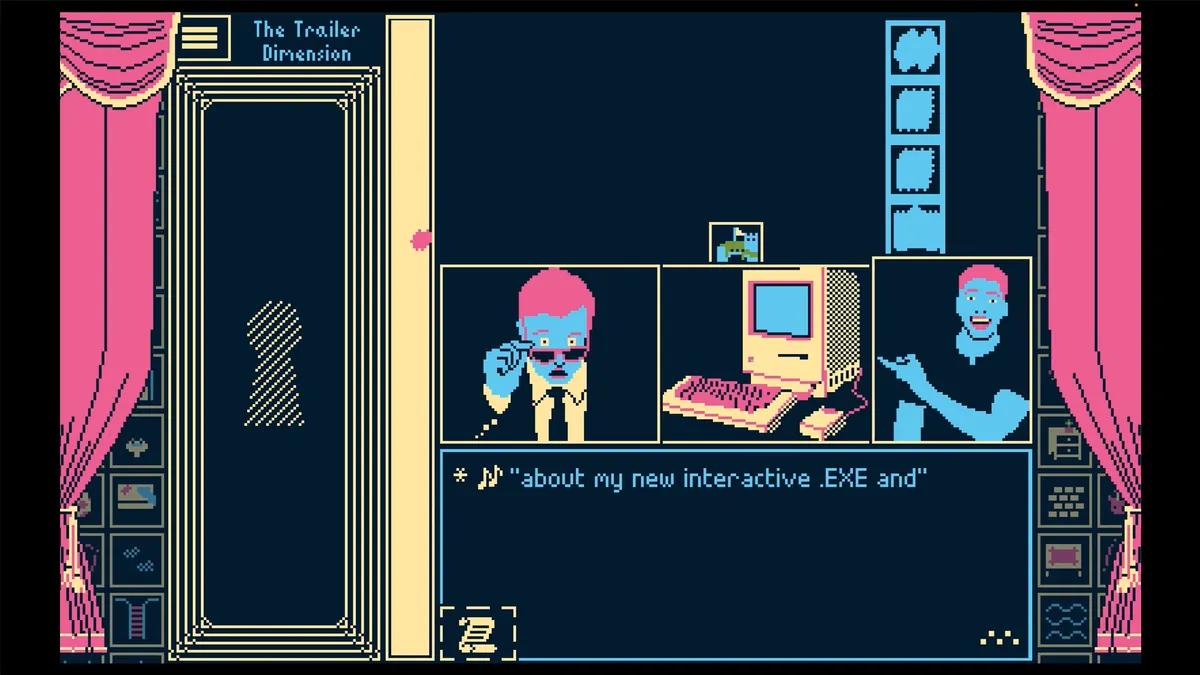
What everyone seems to agree on is the vibe. The game is built on collisions: an easy-listening jazz score under skirmishes between fairy soldiers and warships; lo-fi pixel art that looks like it crawled out of a 1995 office PC; cut-in pop-ups of baseball players hitting home runs and cats nudging cups off counters whenever you destroy an enemy base. There's a recurring "Cult of MARKET," identical men in suits and blindfolds, that exists somewhere between a joke and a thesis. There's also, reportedly, an item that swaps a boss fight for a live musical performance by Thomson himself, drawn out long enough to feel like a punishment for picking it.
I keep coming back to the shower. There's a daily hint mechanic where the protagonist takes a shower and you idly match soap tiles in a tiny grid while clues for the day scroll along the bottom. It's not a puzzle. There's nothing at stake. It's a small, weird, low-pressure thing that exists because someone thought it would be funny to put it there, and that instinct is everywhere in this game.
Lifting Curses and Losing Keys

Outside the daily war, the court is an exploration space full of characters who half-explain things, mysteries that resolve in unexpected ways, and curses on the court's protections that erode as you fail to address them. Fellow Traveller's page frames the structure as roguelike, but the meta-progression is closer to a slow-unfolding adventure game grafted onto the run-based combat — every loss adds a drop of wine to a Comfort glass, and every full glass converts to a starting buff for the next attempt.
This is where the Blue Prince comparison earns its keep. Some of the curses come with goals stated so plainly that you assume there must be a catch, and there is, but the catch isn't hidden — it's just that the path to the goal cuts through three other systems you haven't mastered yet. Some characters will tell you outright how to do certain things. Others won't. The game keeps the broader plot moving regardless, which means you rarely get fully stuck, but it also means the mysteries with the most resistance are the ones you have to decide to chase.
What the Run Leaves Behind
After two weeks with it, I'm still not sure what kind of game Titanium Court is, exactly. The roguelike framing is real, but the runs feel less like attempts at mastery than like episodes of a strange weekly serial — each one ends, the court resets, and the next morning Puck is pouring wine again and the fairies are filing out to a war that means nothing. The mechanics keep producing situations the writing then has to account for, and the writing is good enough that it does.
The match-three argument will go on. I think it's the right argument to be having about this game, and I don't think it has a clean answer. What I keep noticing instead is the shower, the road signs, the home-run pop-ups, the goats demanding tolls, the suited men with blindfolds, the protagonist who can't find her keys or her locks. None of that needed to be there. All of it is.


 Başarıyla kopyalandı... İçeriğimizi paylaştığınız için teşekkür ederiz!:

Yorum