




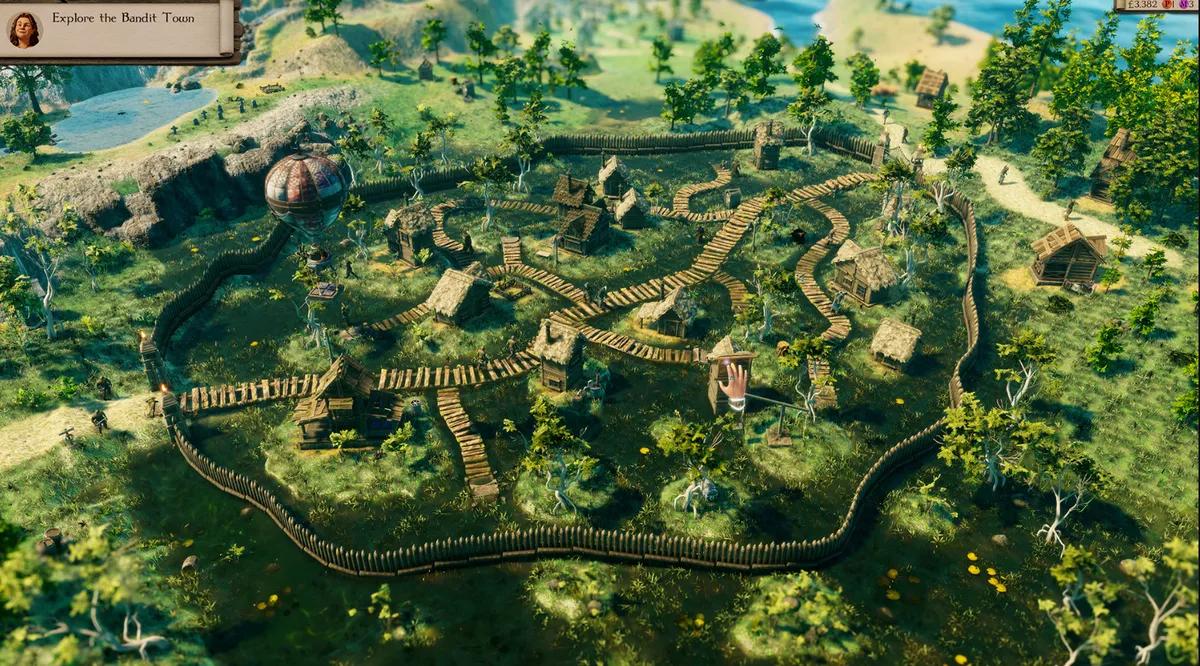
Peter Molyneux'un Albion'u, Tanrısal bir dokunuş ve işletilecek bir fırınla geri dönüyor.










 Steam
SteamMasters of Albion launched in early access on April 22, 2026, on PC via Steam, developed and self-published by 22cans under the direction of Peter Molyneux. The game stitches a daylight city-builder, a nighttime tower defense, and Fable-style third-person adventuring into one loop, all routed through a giant disembodied hand that builds, smites, possesses heroes, and waggles itself at production lines when villagers move too slowly. Early access pricing is $25 with a launch-week sale.
First revealed at Gamescom 2024 and previously codenamed MOAT, the project pulls openly from Molyneux's earlier work: the hand comes from Black & White, the day-and-night structure from Dungeon Keeper, and the voice and tone from Fable. Molyneux has called it "the culmination of my life's work" and, by his own statement, his last game as a developer. The release follows a difficult stretch for 22cans, whose previous title, Godus, spent eleven years in Steam early access before being delisted in 2023, and ships with parts of Albion cordoned off and two planned modes, Master and Rogue, still on the roadmap. Reception has been cautiously warm, with the writing and the hand drawing praise and reservations focused on pacing, performance, and how much of the final game is actually in the box.
The Hand Is the Game

Everything you do in Masters of Albion runs through a giant disembodied hand. It builds settlements, plucks villagers off paths and drops them where they need to be, lobs rocks at the undead at midnight, slings lightning when lightning is needed, and waggles itself at a mill to make wheat process faster. It is the cursor, the avatar, and the only point of physical contact between the player and the world. Eurogamer identified this as the game's quiet structural achievement: that by leaning into the tactility Molyneux first explored in 2001's Black & White, the hand becomes the connective tissue holding three otherwise mismatched genres together. You don't switch between modes so much as move your hand from one task to another.
I think that's most of why the early hours work. The transition from designing a meat pie to ordering troops to repel an undead siege should feel like whiplash. It mostly doesn't, because both actions are routed through the same gesture: point, grab, place, smite. The grammar is consistent even when the systems aren't. The fingers are also funnier than they should be. You can knock things over for no reason. You can pick up a chicken and then keep holding the chicken. You can prod a worker until they look annoyed. None of this is mechanically necessary, and all of it is the kind of texture games rarely bother with anymore.
Where the hand falls short is in its expressive range. The arsenal is small. Fireballs, lightning, rocks, possession, a treasure-finding shovel. Some obvious gestures from the older work are missing — you can't uproot a tree, you can't scoop water, you can't pick up a hero by the scruff and drop them somewhere distant the way Black & White let you do with creatures. The toolkit feels held back by its early access stage, which is the sort of complaint that resolves with patches if it resolves at all.
Pies, Coffers, and the Daily Grind

The biggest time sink in Masters of Albion is also the part the marketing did not prepare anyone for: you spend a lot of it making pies. Orders arrive by hot air balloon. They specify what the customer wants in cryptic terms (wet, cheap, green), and you assemble a prototype from whatever ingredients you've unlocked, hoping you've correctly read the brief. Get it right, and you start manufacturing the dish at scale, which means building a farm, then a mill, then a factory, and then physically holding down left-click on each of them in turn to speed the process up because your villagers move at the pace of a bored toddler.
Mobalytics singled the design layer out as the most polished part of the build so far, and I agree on the prototype side. The recipe puzzle is genuinely satisfying, partly because it rewards lateral reading of the customer's brief and partly because the wrong answers are funny. Trying to fulfill an order for "wet, cheap, green" by drowning a sad bit of lettuce in flavored water shouldn't make you laugh, but it does. The grind that comes after is where the agreement thins out. The recurring complaint across early coverage — that the manufacturing slog drowns out the rest of the game — is fair on its face, but it undersells what's happening underneath.
The economy drives everything. Weapons, walls, hero training, additional regions, godly powers — all of it is paid for in pies and ore and whatever else you're producing that day. The Chosen One, whose primary daily activity is bookkeeping, is the joke, and it's a sharper joke than "isn't it odd that a god runs a bakery" suggests, because the joke is on the player as much as on the character. Whether the joke is good enough to justify how often you have to live inside it, fifteen hours in, is the open question. The hold-button-to-speed-things-up loop is the part of the design that doesn't survive scrutiny. It feels like a placeholder for an automation system that hasn't been built yet.
When the Sun Goes Down

The day exists for the night. Once darkness falls, the undead spawn from fixed points and march toward your settlement, and you get a single window to repel them before dawn. VGC placed this as the game's most overtly Dungeon Keeper-shaped beat — a daytime build phase that earns its keep when you watch it survive contact with hostile waves — and gave the launch a 4/5 partly on the strength of how cleanly that loop holds together. The framing is fair. The night is also where the game stops feeling like a city-builder with combat bolted on and starts feeling like its own creature.
You have options. You can leave your heroes to fight on autopilot and play god, picking off stragglers with lightning and dropping debris on chokepoints. You can possess a hero and fight from third-person at ground level, which is rough — combat is one-button basic — but useful when a wave is breaking through somewhere your hand has been ignoring. You can pre-build turret layouts during the day and let the towers do most of the work while you handle the leakers. The mode shipping at launch is built around this loop, with a manual day-to-night transition that lets you push for the fight when you feel ready. Master mode and Rogue mode, the two roadmap promises, are still missing.
The margins are tight. A wave you've miscalculated for can roll your settlement in two minutes, and the failure state is "do the night again." Several outlets flagged this as the place where satisfaction tips into trial-and-error frustration, and they're not wrong. What I notice in the same situation is that the failure tends to feel diagnostic rather than punitive. You usually know what you got wrong. You usually know what to fix. That's a different texture than the kind of opaque defeat that makes a roguelite-adjacent loop feel arbitrary, even when the practical effect of repeating a hard fight is the same.
Walking Through Albion at Ground Level

The third-person mode is the part of the consensus most worth pushing back on. Outside coverage has mostly landed on it as a charming but undercooked diversion: too thin a world to support meaningful exploration, too rudimentary a combat system to compete with what the inspiration was actually doing twenty years ago. As a piece of design criticism, this is correct. The world is sparse. Hero combat is one button. The Fable comparison doesn't hold up if you treat Fable as the benchmark.
I think treating Fable as the benchmark is the wrong move. The third-person sections aren't trying to be a Fable game. They exist because the giant hand can't reach into fogged areas, so to expand your manufacturing into new biomes you have to walk a hero out there at ground level and reactivate the broken beacons by hand. The mode is functional in the literal sense. It functions as a bridge between the god-game logic of the day phase and the territorial expansion the economy demands. The fact that it's also a brief tonal vacation, with sweary statues, goofy fetch quests, and the option to possess a dog and follow a scent trail, is gravy on top of the structural job it's doing.
I run a hero through a foggy patch, kick some chickens, an optional quest demands I kick, find a stone circle, reassemble a beacon, and the fog clears. The reward is not the journey. The reward is that the hand can now reach a copper deposit. Calling that a cute novelty misses what it's actually for. It's the seam where two different scales of play touch each other, and the game is more interesting for having it than it would be if every territorial expansion were just a click on a map. The thinness of the third-person world is a real flaw. Reading the third-person world as the point of the third-person mode is a different flaw, and the consensus is closer to the second one than the first.
The Trust Tax

There is no honest way to talk about a 22cans early access launch without talking about Godus. Eleven years in early access. A spinoff that died in the same condition. A delisting in 2023. A track record long enough that even forgiving coverage of Masters of Albion has felt obliged to caveat itself with some version of "let's see where this is in a year." Two missing modes and chunks of Albion roped off behind fog are not, in themselves, alarming for an early access launch. They are alarming in the specific context of the developer who made them.
The performance is also rough. Frame rates land somewhere near a juddering 30, even on capable hardware. The UI hides basic options behind tabs that don't make sense, multiple saves don't exist, and quitting to the main menu requires quitting to the desktop and reopening the game. None of this is fatal in early access. None of it is a great look on day one, either, especially given how often the team has been asked, in interviews, to acknowledge the trust deficit they're working against.
What I keep thinking about is that Molyneux has reportedly said this is his last game. If that's true, then the early access window for Masters of Albion is also the last development cycle of his career, and the question of whether 22cans can deliver on the promise of an unfinished build collapses into a more uncomfortable one: how does this story end? The campaign in the box is paced and written better than it had any right to be. The systems lock together in ways that feel deliberate, not accidental, even when individual pieces drag. The hand is a small marvel. None of that was guaranteed.
The trust question is not unanswerable. It's just being asked in real time. Nobody knows what the Masters of Albion are in a year. What it is now is the strangest soft launch a god game has had in a while: charming, lopsided, fifteen hours deep before the production grind starts to bite, with a giant rubber finger doing structural work that no other team in the industry seems willing to attempt at this scale. Whether it grows into the game, its inspirations were is the next eighteen months of patches. The thing on Steam this week is more than the warning labels suggested it would be, which, given the warning labels, is most of the news.


 Başarıyla kopyalandı... İçeriğimizi paylaştığınız için teşekkür ederiz!:



100 mücevhere kadar %5 para yatırma bonusu

Para yatırma ve çekme işlemlerinde %0 ücret.





11 Para Yatırma Bonusu + FreeSpin


EKSTRA %10 PARA YATIRMA BONUSU + ÜCRETSIZ 2 ÇARK DÖNDÜRME

Ücretsiz Kasa ve %100 Hoş Geldin Bonusu


5 Ücretsiz Kılıf, Günlük Ücretsiz ve Bonus

3 ücretsiz kasa ve tüm nakit para yatırma işlemlerine %5 bonus eklenir.

Depozitoya +%5




Yorum