




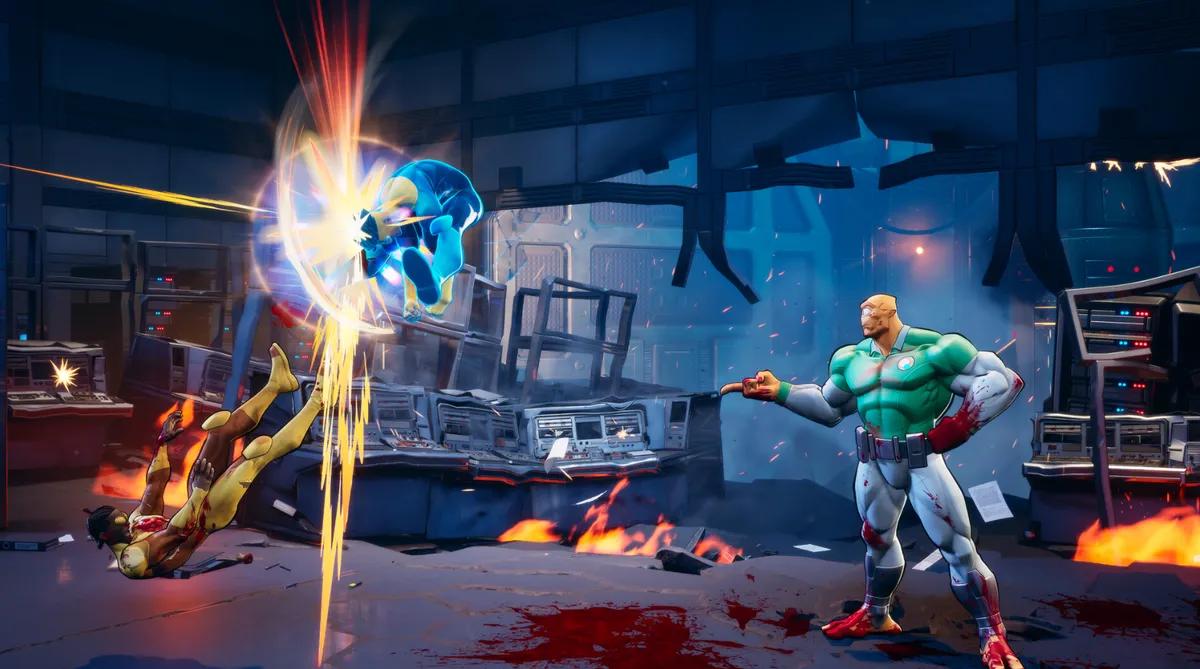
Yoğun bir yayın ayının sonuna doğru Bloody Tag Fighter oyunu piyasaya sürüldü.










 Steam
Steam PlayStation
Invincible VS was released on April 30, 2026, on PlayStation 5, Windows PC, and Xbox Series X, developed by Quarter Up and published by Skybound Games. The 3v3 tag fighter adapts Robert Kirkman's Invincible comic and the Amazon Prime animated series into a 2.5D tag fighter built around 18 launch characters, a two-way combo system with tag-and-counter-tag mind games, and a story mode co-written with show writers Helen Leigh and Mike Rogers, with involvement from Kirkman himself. The game also closes out an unusually crowded release window.
As we said earlier, April is packed with major game releases. Capcom's Pragmata shipped this month, and Housemarque's Saros landed on PS5 within the same window, both pulling oxygen out of the room ahead of any tag-fighter launch trying to find its audience. Quarter Up's pedigree comes from the core team that built the 2013 Killer Instinct reboot, and that lineage shows up in the combat philosophy as well as in the rollback netcode and the detailed tutorial the studio has been pushing hard in pre-launch coverage. Critical reception has settled along clean lines: the fighting earns strong notices, the supporting modes draw conditional compliments, and the hour-long story campaign has become the focal point of nearly every conversation about what isn't here.
Blood on Everything

The first thing every match teaches you is that Invincible VS is going to be wet. Damage doesn't just chip away at health bars. It paints the characters. Faces redden as combos land, costumes crust over, blood arcs across the screen on every clean connect, and a finisher dubbed "overkill" can end a regular match by bursting an opponent into pieces. The aesthetic is faithful to the show's most-quoted scenes, the ones where Mark Grayson realizes a man can be both a hero and a chunk on the pavement, and Quarter Up has translated that imagery into a game that makes the grotesque legible without ever quite making it serious.
I keep noticing how well the kinetic feedback maps onto the source. A Viltrumite punch hits with the heft a Viltrumite punch should hit with. A grappler like Cullen telegraphs his throws the way a comic panel would, a beat of weight before the impact. The arcs of motion borrow from the same "animation on twos" technique the Spider-Verse films popularized, which gives the cutscenes their texture and bleeds into the fight choreography enough to make standard string combos feel hand-drawn rather than rigged. Polygon flagged this as the one area where the game outperforms its source material, calling the brutally kinetic action a match for the comic's and TV show's best fight scenes. The compliment lands. The mode is fighting for the sake of fighting, but the fighting itself looks the way the show's animators clearly wanted it to.
The Counter Tag Mind Game

Underneath the spectacle is the system that the studio's Killer Instinct lineage actually shows up in. Every combo is a two-sided negotiation. The attacker manages a meter that fills as the combo extends and drops the combo if it tops out. The defender watches the same meter and waits to tag in a teammate at the moment of greatest pressure. If the defender's tag lands cleanly, they execute a Counter Tag that resets the situation to neutral and turns the round on its head. If the attacker reads the tag attempt and feints, the defender is left wide open. If the attacker feints when no tag was coming, the attacker eats the punish.
When both players know the system, this is the best thing the game does. IGN spent a lot of words on this, framing the Counter Tag minigame as the central pleasure of Invincible VS and the closest 2026 has come to recovering Killer Instinct's two-way combo conversation. I think that's the right read on what makes this fighter distinct, but I'd push back on where IGN landed on the second escape mechanic, the Assist Breaker. The complaint is that Assist Breakers cost too little for what they do, since each character starts the round with three full meter bars and can dump them on combo escapes essentially at will. The argument is structurally sound. Most fighters cap this kind of get-out-of-jail-free option to once a round.
What that read undersells is the trade. Every Assist Break shaves fifty percent off one assist character's max health and locks the assists out on a meaningful cooldown. Against a player who understands what they've just paid, the math doesn't favor mashing the button repeatedly. Against a player who doesn't, yes, you drag out matches and burn time for no reason. The mechanic is tuned for the players who read the manual, which is a different problem than the mechanic being broken. Patches will sort the numbers. The conversation underneath the numbers is more interesting than the verdict-level take suggests.
One Hour and a Cliffhanger

The story mode opens on a fight you've technically seen before, played wrong. Mark and Omni-Man are throwing punches in what looks like the season-one subway showdown, except Omni-Man is kitted in a traditional Viltrumite uniform, fighting alongside Lucan and Thula, and the geometry of the scene is off in a way the camera keeps drawing attention to. The piece-it-together opening is the strongest thing the campaign does. It works because the show writers helped construct it, and it works because the game leans on the Spider-Verse style for its cutscenes, which keep the reveals legible even when the dialogue is unspooling exposition.
It also wraps in roughly an hour. DualShockers treated the campaign as a genuine surprise, calling it one of the better single-player offerings in any recent fighting game, and crediting the show's writing staff for an authenticity that elevates the cutscenes. I agree on everything except the conclusion, because there isn't one. The campaign builds, the campaign accelerates, and the campaign ends mid-arc on a cliffhanger that reads less like a resolution than a placeholder for a DLC continuation that hasn't been announced. An hour of build-up needs more than a hard cut to credits, and the absence of a proper landing leaves the mode feeling like a trailer for a story rather than the story itself.
That's also where I lean against the harshest read in the press. The argument from one corner of early coverage is that the campaign fails to engage with the show's central preoccupation, which is the toll violence takes on the people who survive it. That's true as a description. It's also a strange standard to apply to a fighting game's filler-episode-length campaign. The show needed four seasons to build the emotional architecture being missed. The game has sixty minutes, eighteen fighters, and a job to introduce the ones the audience hasn't seen on screen. Asking for the version that examines the psyche of someone whose father smashed him through a subway full of commuters is asking for a different game entirely. The version on disc could absolutely use a real ending. It can't reasonably be expected to also be season five.
Eighteen Fighters and an Avatar

The roster is the part where the show's wide bench finally pays off. Eighteen characters at launch, with a meaningful spread across speeds and archetypes, and a brand-new fighter created by Kirkman specifically for the game named Ella Mental, an Avatar-style elemental controller who doesn't exist in the comic or the show. The Viltrumite problem the marketing was always going to face, namely too many strong flying punchers in the same family tree, is real, and Quarter Up has solved it by giving each Viltrumite a distinct silhouette of attack. Cullen grapples. Anissa cuts at close range with a hand held flat as a blade. Thula weaponizes the braid the show has been daring you to grab for four seasons. Omni-Man hits with the weight the character is supposed to hit with.
Outside the Viltrumite block, the spread widens further. Cecil teleports across the screen and conjures cyborg zombies. Monster Girl and Titan stack armored attacks to the point of obnoxiousness if you don't know how to deal with armor. Rex Splode plays a zoner who fans of the show didn't know they wanted as a zoner until they fought him. Atom Eve floats and reshapes the field. The 18-character launch lineup compares well to other tag fighters' day-one rosters and leaves room for the DLC pipeline to bring in obvious fan picks like Angstrom Levy and the Mauler Twins without making base-game absences feel like content that was held back to sell back later.
The peripheral features don't quite keep up. The training mode ships without combo trials and without character guides. Replays save your own matches but offer no replay takeover and no way to lab from another player's footage. Arcade mode is functional. Online has casual and ranked, custom loadouts, and arcade-stick support, with a profile-tag customization system pulling more than 300 cosmetic elements from the comic and the show. None of this is bad. None of it is up to the standard the combat itself sets, and that's the gap that has to close in the post-launch updates.
What the Match Leaves Behind
I keep coming back to the question of what Invincible VS actually wants to be. The fighting argues for a tournament title aimed at players who miss the way Killer Instinct made every interaction a mind game. The story mode argues for a fan-facing showcase that lives or dies on whether you've watched at least the first three seasons of the show. The roster argues for a celebration of the comic's supporting cast, with a new original character thrown in to tease the audience that this game is going to keep finding things to do with the IP. None of these instincts contradict each other. None of them quite cohere either.
The combat is the strongest argument the game makes for itself, and it's strong enough that the rest of the package gets carried. It's also the kind of combat that asks the audience to do work, play the tutorial, learn the Counter Tag mind game, understand what an Assist Breaker actually costs, and tag fighters in 2026 have a track record of losing players who aren't willing to do that work in the first month. Whether Invincible VS is the version of this premise that holds the audience long enough for EVO 2026 to settle the conversation is a question the next ninety days will answer. What's on the disc this week is a fighter that punches hard, bleeds harder, and ends its story too early. Depending on how you squint, that's either a reasonable summary of the source material or a list of the work still to come.


 Başarıyla kopyalandı... İçeriğimizi paylaştığınız için teşekkür ederiz!:



100 mücevhere kadar %5 para yatırma bonusu

Para yatırma ve çekme işlemlerinde %0 ücret.





11 Para Yatırma Bonusu + FreeSpin


EKSTRA %10 PARA YATIRMA BONUSU + ÜCRETSIZ 2 ÇARK DÖNDÜRME

Ücretsiz Kasa ve %100 Hoş Geldin Bonusu


5 Ücretsiz Kılıf, Günlük Ücretsiz ve Bonus

3 ücretsiz kasa ve tüm nakit para yatırma işlemlerine %5 bonus eklenir.

Depozitoya +%5




Yorum