




Tribute Games, Kendine Güvenen ve Dengesiz Bir Dövüşçüyle Marvel'ın Kozmik Köşelerini Yeniden Ziyaret Ediyor










 Marvel
 Steam
Steam Oyunlar
 Review
MARVEL Cosmic Invasion review sets out to examine how Tribute Games applies its familiar beat ’em up craft to one of Marvel’s most unruly story spaces. The result is a functional, often engaging action game that leans on strong character work to offset structural predictability and narrow enemy sets.
The assessment draws on Will Borger’s review on IGN, which frames the release as a bold tag-team experiment that succeeds on concept and character expression more than on level innovation or breadth of foes.
Cosmic Invasion builds its premise around Annihilus and the Annihilation Wave, a threat that sweeps across the galaxy with the blunt force of a classic crossover arc. The plot serves as scaffolding: sustainable enough to send a rotating roster of heroes into familiar flashpoints. Tribute Games doesn’t complicate the narrative beyond its function. It places the burden of identity elsewhere, namely on the playable lineup and the idea of building a tag-based beat ’em up inside a traditional stage-by-stage structure.
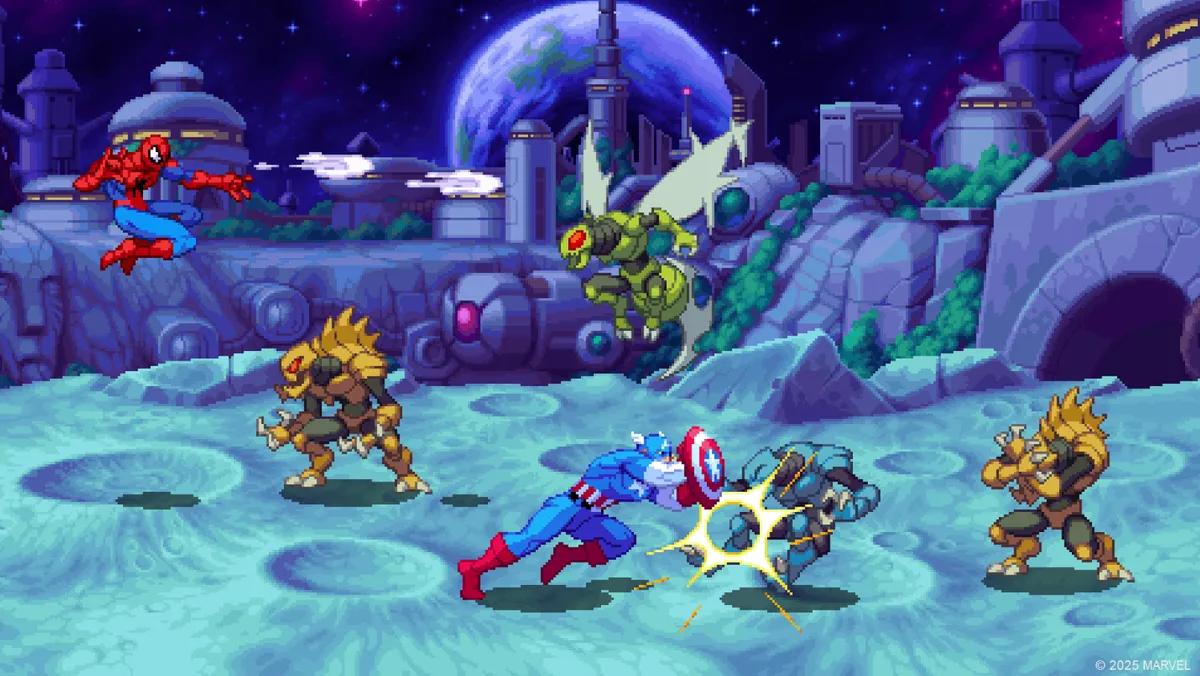
The roster carries much of the weight. Tribute draws from multiple corners of Marvel’s catalogue, and its selections reflect an interest in cosmic arcs rather than the narrow set of mainstream staples. Wolverine, Spider-Man, Storm, and Captain America appear as expected, but they share space with characters who rarely headline action games. Beta Ray Bill replaces Thor. Phyla-Vell enters with a skillset tailored for movement and range control. Cosmic Ghost Rider and Silver Surfer add high-impact screen presence. The result is a cast that sits between the conventional and the eccentric, anchored by polished animations and expressive sprites.
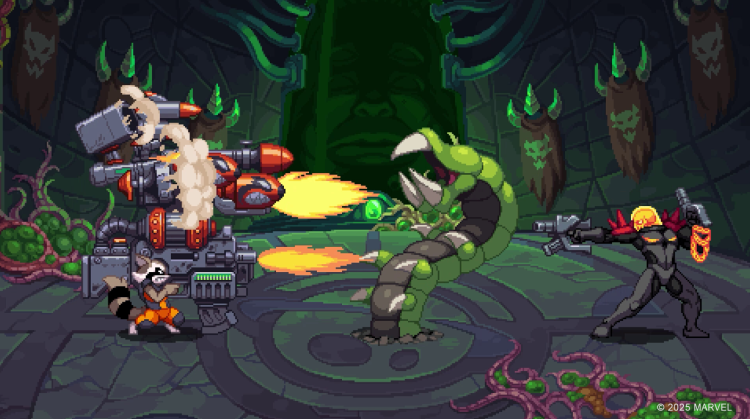
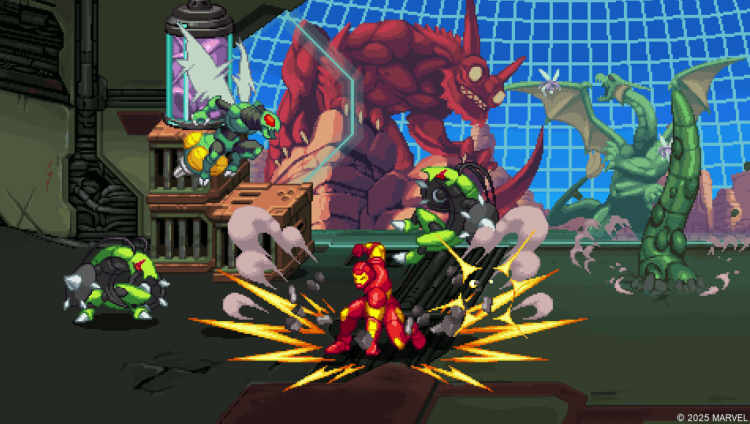
The art direction shapes much of the game’s appeal. Characters move with deliberate detail: hair, clothes, and posture behave with enough nuance to make the sprites feel alive, yet the presentation avoids visual excess. Tribute’s familiarity with pixel-based action allows each hero to occupy distinct physical space. Wolverine’s tense stance contrasts with She-Hulk’s heavier frame. Phyla-Vell extends her reach with her sword and teleports to it to maintain pressure. Iron Man’s heavy beam attack mimics the wide sweeps of fighting-game supers, while Nova punches through clusters with piercing bursts. These differences help the cast avoid merging into a single tempo, even when two characters fill similar combat roles.
Audio performance reinforces the visual identity. Voices match established interpretations closely enough that long-time readers or viewers can recognize the tonal choices without distraction. This cohesion makes the roster feel curated rather than assembled for quota.
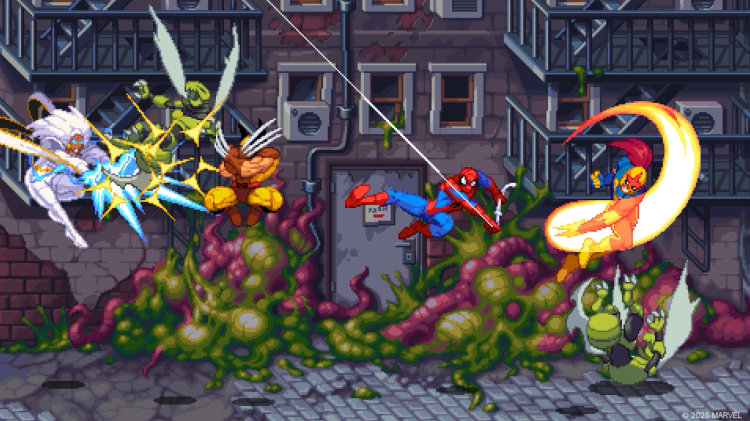
Stages run through recognizable Marvel locations: New York City, Wakanda, the Savage Land, Genosha, and Fort Galactus, among others. Each uses basic environmental hazards and short sub-routes that occasionally split and rejoin. Levels last roughly ten to fifteen minutes, reinforcing a brisk pace, but the overall structure rarely pushes beyond safe conventions. Challenges provide side objectives tied either to specific characters or to the stage itself. They encourage roster experimentation, though they do not reconfigure moment-to-moment play.
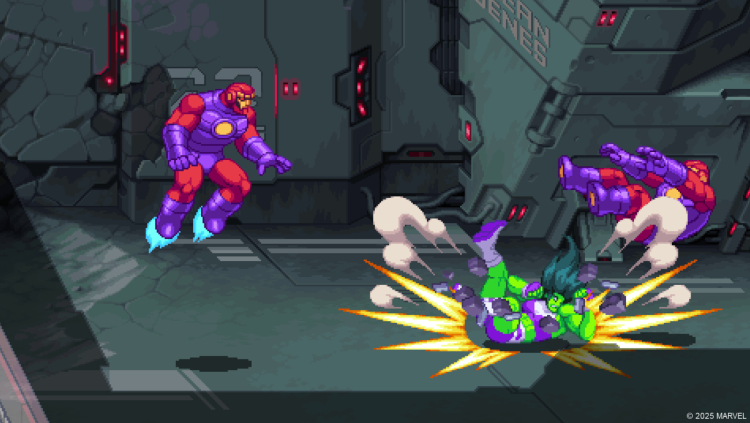
Cosmic Invasion’s core interest lies in how characters interact during combat. The tag-team system allows each player to control two heroes, swapping between them and calling the inactive partner for assists. Assists can extend combos, launch enemies, or fire specials that reset spacing. This system enables improvisation even when the level design stays static. Finding combinations that complement each other—such as pairing a ranged specialist with a rush-down bruiser—creates a sense of discovery that outlives the campaign.
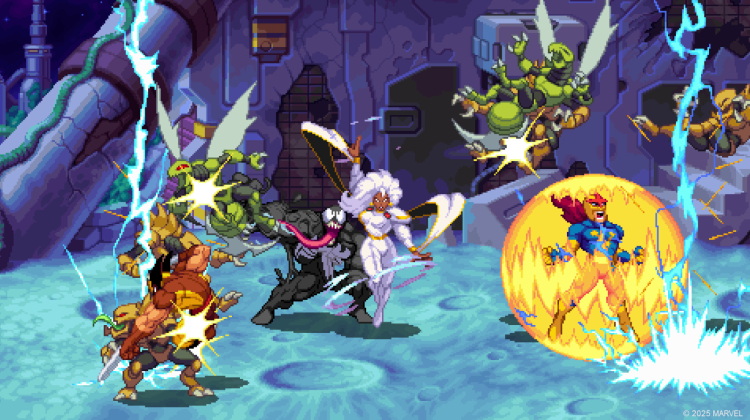
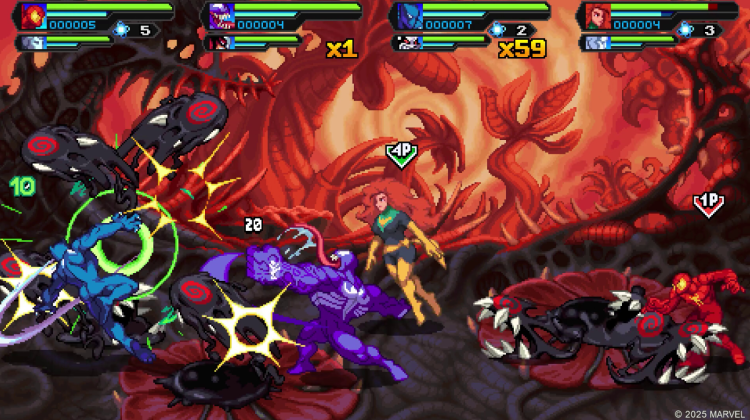
Combat variation improves in cooperative play. Up to four players can participate, each managing two characters. The flow becomes more chaotic but also more inventive, as assist timing and tag choices gain additional layers when multiple players coordinate or collide in shared space. Characters level up independently, gaining health and passive upgrades that reward sustained use without locking players into rigid progression paths.
Despite these strengths, enemy variety remains limited. Most encounters rely on a recurring set of minions differentiated only by color or minor behavior changes. This is typical of the genre but becomes more noticeable when the character roster is this diverse. Boss fights provide spikes of personality, though some clearly serve as previews for heroes that join the roster later. These encounters can produce unintentional humor, such as the Silver Surfer repeatedly falling off an elevator platform and drifting back upward for another round.
Between missions, the Vault offers a break from combat. The Hero Lab tracks progress, while the Nova Corps Files provide short lore entries about heroes and enemies. Music tracks unlock gradually, and the Cosmic Matrix allows players to spend earned Cubes to open new palettes, profiles, and additional files. The Matrix can also form visual patterns depending on the nodes selected, lending a small but pleasant layer of customization.
The campaign spans fifteen stages plus a tutorial, completing in about three hours on a first run. Its length fits the genre but limits the arc of escalation. Movement and combat maintain clarity and momentum, though the repetition of common enemy types prevents friction from building steadily. The tag system mitigates this by allowing players to reconfigure their approach mid-sequence, but the encounters themselves rarely push the mechanics to their limits.
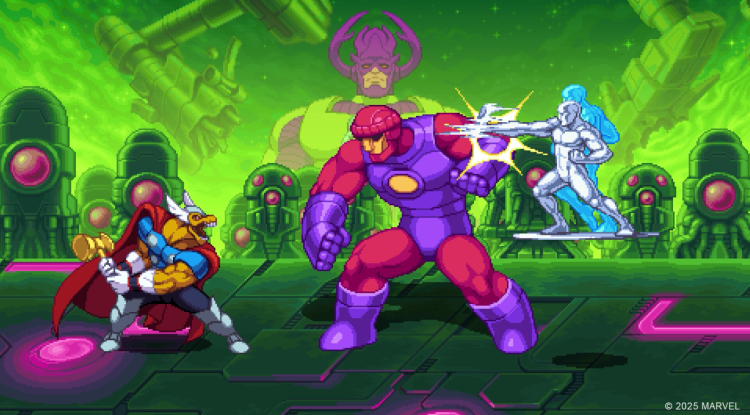
Co-op elevates the experience considerably. Tribute’s design favors the social rhythm of a shared beat ’em up, where the satisfaction comes from layered attacks, synchronized assists, and the escalating noise of overlapping specials. Solo play remains solid, yet the game appears built with groups in mind.
Cosmic Invasion’s production values carry a confident throughline, even when mechanics remain conservative. Spritework stays consistent, animation quality never dips, and the audio direction aligns with the intended tone. The game benefits from Tribute’s history with character-driven action and maintains a steady hand in representing Marvel’s cosmic domain without leaning on cinematic tropes.
The game’s shortcomings concentrate in familiar areas: thin enemy rosters, predictable level flow, and light strategic pressure. None break the experience, but they keep the game from reaching the sharper edge that some genre competitors achieve. The design experiments with the tag system, not with structural variety, leaving much of the innovation to character-to-character differences rather than stage-to-stage changes.
Still, the roster’s breadth and the depth of its move sets offer tangible replay value. Heroes feel distinct enough that switching them alters how players approach crowd control, mobility, and damage timing. The game rewards committing to several characters at once, not just one main, because the tag focus makes synergy more important than isolated mastery.
Tribute uses the Marvel setting to support experimentation rather than overshadow it. By centering cosmic and fringe characters, the game avoids the fatigue associated with more common MCU-aligned adaptations. Its tone aligns with classic event arcs: high stakes, straightforward conflicts, and heavy reliance on ensemble action. It never attempts a sprawling narrative or a subversive twist; it uses the story as a frame around the roster and the combat.
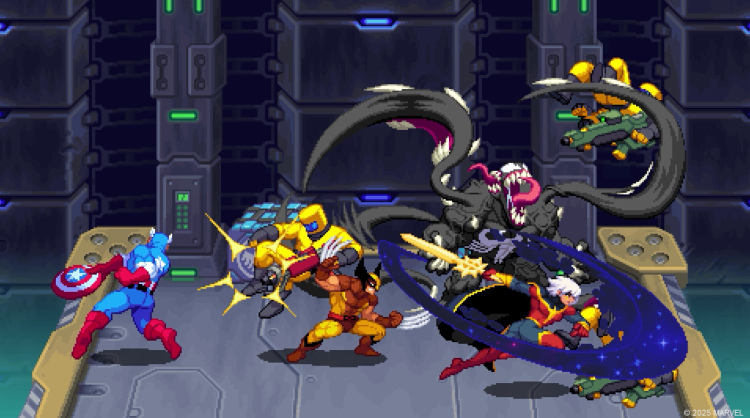
Cosmic Invasion’s modest scope pairs well with its expressive cast. It is not designed as a genre benchmark but as a stable, replayable beat ’em up with a novel tag system and an unusually eclectic selection of heroes. Its most successful elements lie in how those heroes animate, interact, and combine, not in the stages they travel through. The game settles into a reliable cadence: punch through waves, swap heroes, trigger assists, level up, test a new pairing, and move on. This consistency becomes a virtue once players accept the bounds of the design.
By the final stages, the rhythm holds steady. The game delivers familiar encounters, competent boss fights, and steady opportunities to test new combinations. The variation between heroes sustains engagement even when the enemy lineup repeats. Tribute’s attention to detail in animation and ability set gives each swap a purpose, and assists keep combat in motion even during slower sequences.
The optional Vault and Matrix systems provide mild long-term goals for completion-minded players. They do not shift gameplay but extend the sense of progress. For players accustomed to beat ’em ups, these systems function as light peripheral incentives.
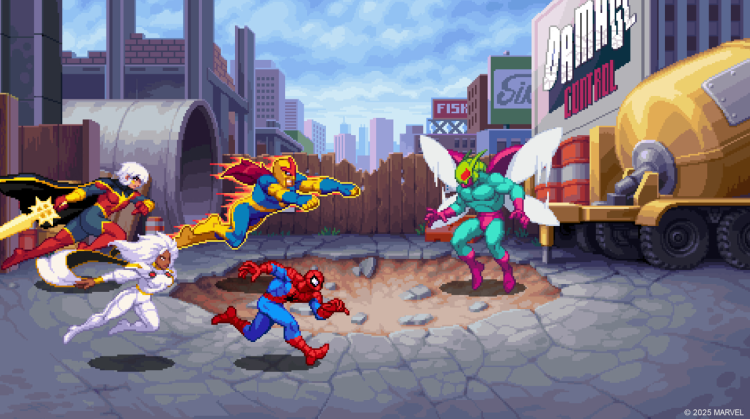
Cosmic Invasion thrives when players lean into experimentation and cooperative play. Its systems reward curiosity, and its roster supports varied paths through the campaign. The game’s limitations come from conservative level design and a narrow enemy pool, not from its core mechanics.
As a complete package, Cosmic Invasion presents a competent, character-driven beat ’em up shaped by Tribute Games’ craftsmanship. It succeeds in delivering accessible tag-team action, expressive spritework, and a capable cast drawn from Marvel’s cosmic catalogue. It falls short of redefining the genre but fulfills its goals with clarity and consistency.
Cosmic Invasion stands as a solid addition to the studio’s portfolio. It highlights the value of thoughtful roster design and proves that even restrained mechanical ideas can carry a full game when executed with care. Its identity comes from its heroes and the interplay between them, and that foundation holds firm throughout its run.
MARVEL Cosmic Invasion is available to play on PC (Steam)


 Başarıyla kopyalandı... İçeriğimizi paylaştığınız için teşekkür ederiz!:



100 mücevhere kadar %5 para yatırma bonusu

Para yatırma ve çekme işlemlerinde %0 ücret.





11 Para Yatırma Bonusu + FreeSpin


EKSTRA %10 PARA YATIRMA BONUSU + ÜCRETSIZ 2 ÇARK DÖNDÜRME

Ücretsiz Kasa ve %100 Hoş Geldin Bonusu


5 Ücretsiz Kılıf, Günlük Ücretsiz ve Bonus

3 ücretsiz kasa ve tüm nakit para yatırma işlemlerine %5 bonus eklenir.

Depozitoya +%5




Yorum